
On the morning of 15 February 2023, during a Senate Estimates hearing, Australia’s Foreign Minister Penny Wong and Defence Secretary Greg Moriarty were asked to respond to a simple but loaded question by the Greens Senator, Jordon Steele-John:
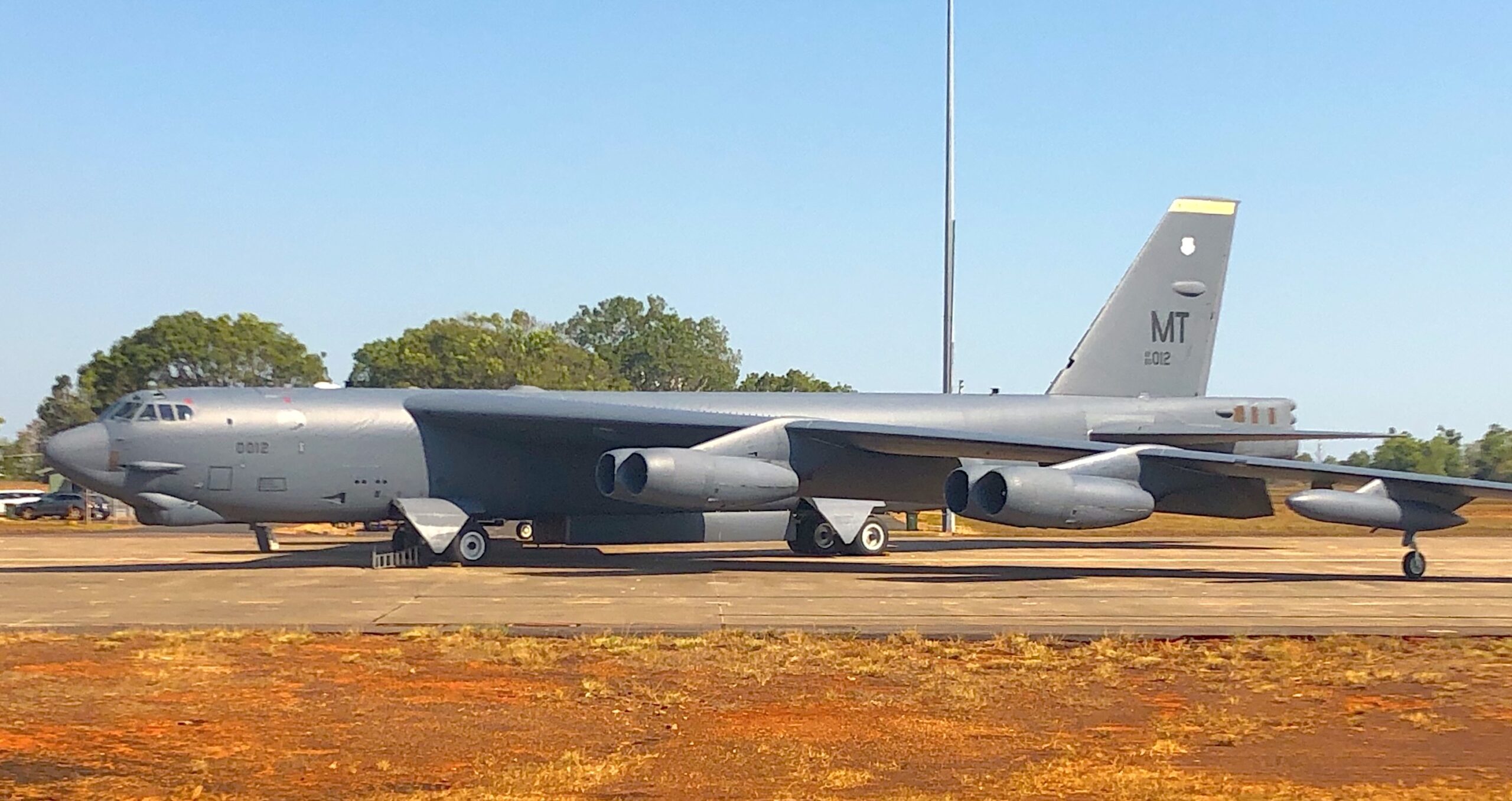
“I’m seeking on behalf of the community to get a firm commitment from the government that the [US] B-52s [long-range bombers] cycling through Australia will be solely conventionally capable, not nuclear capable.”
Senator Steele-John was trying to establish whether Australia would be hosting nuclear-capable bombers, which would undermine Australia’s nuclear-free status and increase its exposure to nuclear‑armed conflict. Adversaries, namely China, as Declassified Australia has exposed, would treat these aircraft as potentially nuclear‑armed, increasing the risk Australia could be targeted in a nuclear escalation.
Senator Wong consulted with Defence officials on the questions before providing an answer. After the mid-morning break, Secretary Moriarty addressed the question. In their report, Performing Fealty in a Nuclear Alliance, Vince Scappatura and Richard Tanter – experts on US military and intelligence facilities in Australia – describe Moriarty’s response as a “boilerplate formulation”:
[S]tationing of nuclear weapons in Australia is prohibited by the South Pacific Nuclear Free Zone Treaty, to which Australia is fully committed…Successive Australian governments have understood and respected the longstanding US policy of neither confirming nor denying the presence of nuclear weapons on particular platforms. Australia will continue to fully comply with our international obligations, and the United States understands and respects Australia’s international obligations with respect to nuclear weapons.
In other words, Australia has a nuclear weapons-free policy but would let the US circumvent it, which makes one wonder why the Foreign Minister felt she needed time to consult. Hansard documents prove that variations of this response have been used since at least 2006.
Liberals past ‘no nukes’ policy
Following the Soviet invasion of Afghanistan in 1979, in an attempt to counter Soviet regional expansion, Washington asked Australia if the US might fly B-52 bombers over the north of Australia for training purposes. Australian Liberal Prime Minister Malcom Fraser agreed.
A year later, Fraser agreed to a second American request for Indian Ocean maritime surveillance flights staging through Darwin. This time he required that the B-52s be “unarmed and carry no bombs” – meaning no nuclear weapons. Fraser went even further and forced the US to make this public, which was an unprecedented request by an ally and contrary to the US practice of neither confirming nor denying the presence of nuclear weapons on their aircraft or ships.
It’s clear Fraser held a deep distrust in America, says Tanter – who worked with Fraser on the second half of his 2014 book ‘Dangerous Allies’. This distrust had deepened after the Pentagon Papers revealed the US government had lied to the American and Australian public about the Vietnam War. Fraser also knew there could be situations where Australian and US interests would not align. US bombers flying operations from Australia raised questions of sovereignty.
While in opposition, Labor bitterly opposed and ridiculed Fraser’s protocol, but when Labor leader Bob Hawke took office in 1983, they kept it. By the end of the Cold War, in 1991, US B-52 missions wound down, and Fraser’s arrangements were essentially forgotten, rather than held onto as a model worth preserving. Every subsequent government has allowed the US military presence to expand without conditions placed on the carrying of nuclear weapons in Australian sovereign territory.
Australia’s nuclear posture has changed
Since the 1960s, secretive facilities at Northwest Cape, near Exmouth in Western Australia, and Pine Gap, near Alice Springs in the Northern Territory, have supported US early warning, communications and targeting operations – essential for nuclear war planning. These facilities on Australian soil, and our reliance on US extended nuclear deterrence, implicate us in US nuclear operations.
Under the Australia-US alliance, the US is preparing to deploy up to six B-52 bombers to RAAF Tindal airbase, near Katherine in the Northern Territory from this year. Will they be conventional-only bombers, nuclear-capable, or a mixture of both? And will the government be told?

Under AUKUS, the trilateral security partnership, US Virginia-class attack submarines will be regularly arriving at HMAS Stirling near Perth from 2027. Although this has not been specified, Vince Scappatura, a lecturer from the School of International Studies at Macquarie University, says it is possible that the submarines will be armed with nuclear weapons at some point. Although these and older attack submarines have been visiting Stirling for routine maintenance for a long time, they will become “de facto homeported at HMAS Stirling,” Scappatura says. In this way, it is conceivable that Australia might in the near future directly support nuclear combat missions from Australian soil.
Professor Gareth Evans, Labor’s Foreign Affairs Minister from 1988 to 1996, told me Australia has been “painting targets on our backs all over the place” on the assumption that the alliance is indispensable.
While upholding the Labor government policy on ‘neither confirm nor deny’ presence of nuclear weapons on visiting US aircraft, Evans was active on nuclear disarmament issues while in office, helping Prime Minister Paul Keating initiate the 1996 Canberra Commission on the Elimination of Nuclear Weapons. Since leaving office Evans has continued his work on disarmament issues and led the 2009 International Commission on Nuclear Non-proliferation and Disarmament report Eliminating Nuclear Threats: A Practical Agenda for Global Policymakers.
Performing strategic ambiguity
Later in the 2023 Senate Estimates exchange, Greens Senator David Shoebridge tried to clarify if our obligations under the South Pacific Nuclear Free Zone Treaty (SPNFZT) – also known as the Treaty of Rarotonga – restrain Australia from permitting nuclear armed B-52 bombers in Australia.
Wong quickly jumped in, asserting:
“No. You’re reading more into it. The statement says, ‘There is no impediment under this treaty or the nuclear non-proliferation treaty to the visit of foreign aircraft to Australian airfields or transit of Australia’s airspace’.”
The responses of Wong and Moriarty – who is now serving as Australia’s Ambassador to the United States – used “strategic ambiguity” as a shield to deflect Greens’ questions. It’s what Scappatura and Tanter describe as “public performance by political leaders”, which often involves obfuscation, displaced logic, and the denial of reality.
Under the Treaty of Rarotonga, ‘stationing’ of nuclear weapons in Australia is prohibited, but ‘transits’ and ‘visits’ are permitted. Dr Monique Cormier, an Associate Professor in the Faculty of Law at Monash University, told me that the line between ‘transiting’ and ‘stationing’ is “open to a lot of interpretation”.
Reflecting on the 2023 exchange, Professor Richard Tanter, a senior research associate at Nautilus Institute, says Wong went to extraordinary lengths to avoid using the phrase “nuclear-capable bombers” herself. Although Tanter has been involved in peace, security, and nuclear issues for the last fifty years, he says he was still surprised by Wong’s obfuscation.
In another Senate Estimates hearing in December 2025, Senator Shoebridge asked if visiting US nuclear-capable and possibly nuclear-armed vessels would be permitted into Australian waters. This time, the answer was different.
Mr. Bernard Philip, Defence’s First Assistant Secretary for International Policy, replied there was “no impediment” under the Treaty of Rarotonga to prevent dual-capable foreign platforms visiting or transiting Australia’s airspace or waters. This undermines Senator Wong’s 2023 assurance that the US nuclear-powered submarines visiting and rotating through Australia under AUKUS would be conventionally-armed only.

In a parliamentary exchange in March this year, Independent Senator for Victoria Lidia Thorpe explicitly asked Senator Wong if the government would ask for US transparency about the presence of nuclear weapons in Australia. If not, would it accept that “nuclear weapons could be launched by planes or submarines being based or hosted by Australia?” In response, Senator Wong stated emphatically that Australia does not seek to be nuclear armed, “Full stop. We don’t,” she said.
By answering that Australia does not seek nuclear weapons, Wong deflects the question put to her.
These exchanges highlight a deep contradiction in Australian Labor Party values. Senator Wong has claimed that the ALP shares the objective of a “world free of nuclear weapons”, yet refuses to rule out the possibility that US nuclear weapons could enter or be launched from Australian soil, skies or waters.
Monique Cormier believes it would “almost certainly” be considered unlawful for the US or UK to launch nuclear weapons from Australian territory. This would be a clear example of “deployment” of nuclear weapons, which is prohibited under the Rarotonga Treaty’s definition of stationing, she says.
Otherwise, says Cormier, if nuclear weapons are being lawfully transited in Australian territory, it’s “virtually certain” the Australian public wouldn’t know they were here, given the US neither confirms or denies the presence of nuclear weapons aboard their vessels. “Even if the Australian government knew,” says Cormier, “I can’t imagine they’d tell the public.”
Australia’s contradictory defence policy stems from three underlying policy positions: neither confirm nor deny, full knowledge and concurrence, and extended nuclear deterrence.
Neither confirm nor deny: ‘love it or hate it’
Since 1948, Australia has accepted the US policy to neither confirm nor deny (NCND) if nuclear weapons are on visiting aircraft or ships. Neither confirm nor deny became more widely used in the 1980s, when US ships, carrying nuclear weapons as a normal practice, visited Australian ports semi-regularly.
I asked Gareth Evans why Australia accepted this policy. He replied:
“It was the only way of coping with the reality of our alliance commitment to the United States – love it or hate it. It was a way of walking that particular tightrope, which is the time-honoured way that US partners and allies have dealt with that. That’s not an Australian phenomenon; it’s a pretty universal phenomenon.”
Australia’s stance ensures compliance with our obligations under the Rarotonga Treaty, while allowing US nuclear-capable bombers and submarines to visit. It’s a delicate balancing act of alliance loyalty and legal obligations. Evans claims this means Australia cannot be “sucked into a direct nuclear engagement role”.
But, Vince Scappatura says that through hosting B-52 bombers, together with support infrastructure and participation in interoperability exercises, Australia would, “for the first time in history, be in a position to support potential nuclear combat missions from Australian soil.” Adding to this, Tanter says:
“There is nothing in the Rarotonga treaty that prevents Australia being sucked into direct support for nuclear operations from Australian bases.”
There is also a fundamental contradiction in how the NCND applies to Australia, Scappatura told me.
As part of the New START Treaty obligations (which expired earlier this year), the United States was required to inform the Russian Federation which of its B-52 bombers were conventional only and which were nuclear-capable. Says Scappatura:
“So, if the Russian Federation can know, there can be no credible security reasons why a loyal, reliable, ally such as Australia – with a so-called ‘special relationship’ with the United States – can’t also know which ones are conventional only and which are nuclear-capable.”
I asked Evans how the NCND policy is rationalised today, given the rise in global conflict, increased nuclear weapons threats and the erratic nature of the current US President. Evans says it depended on how much weight Australia put on the US alliance.
“If you think that maintenance of that alliance and the US commitment to our security is absolutely indispensable to our future, then you are going to take the view that anything that keeps that alliance alive… is very important.”

Evans himself sounds increasingly sceptical about the value of the Australia-US alliance, saying he was “betwixt and between”. He does, however, see three main benefits in it: logistical support, intelligence sharing and access to high-technology weaponry.
For Evans, the balance for Australia is still tipped, for now, towards maintaining the alliance. Whether or not one sees the alliance as important “or more a liability; more a risk than a reward, that’s a matter for real debate.”
‘Full knowledge and concurrence‘
Where Australia allows the US to use its facilities for defence purposes, it is supposed to have “full knowledge and concurrence” of US activities on Australian soil. But this does not mean “Australia approves each individual activity or task undertaken”. Rather, Defence Minister Richard Marles said in 2023, it means that we “agree to the purpose of activities conducted in Australia, we are aware of the capabilities being used, and understand their expected outcomes.”
So, does Australia not know what the US does on its soil, or do we know, but look the other way?
Scappatura and Tanter believe Australia cannot have it both ways. It either does not know the nuclear status of visiting aircraft, ships and submarines – undermining its claims of sovereignty – or does know, but is unable (or unwilling) to share. (The Foreign Minister and Defence Minister did not respond to repeated requests for comment sent to them by Declassified Australia.) “To me,” says Scappatura, “that’s humiliating. It’s humiliating for Senator Wong; it’s humiliating for me as an Australian citizen.”
Extended Nuclear Deterrence
Associate Professor Tilman Ruff from the University of Melbourne is a co-founder and founding chair of the Nobel-prize winning organisation ICAN – the International Campaign to Abolish Nuclear Weapons. He understands the intergenerational trauma and legacy of war: his family were German immigrants in Palestine who lost many family members during both world wars. They were imprisoned as slave farm labour for the British and then interned in Australia till 1947.
Both of his grandmothers told him if war broke out again, “They wanted the first bomb to drop on their heads because they didn’t want to live through another one,” he says.
It wasn’t until after medical school, however, that Ruff learnt about the impacts of nuclear weapons and understood the responsibility on health professionals to campaign against their existence. Since then, he has dedicated his life to abolishing “the world’s worst weapons”. This includes debunking the idea of ‘nuclear deterrence’ – where a state possesses nuclear weapons to dissuade an adversary from attacking – and its variant, ‘extended nuclear deterrence (END)’ – the acceptance of the possible use of nuclear weapons on one’s behalf. Ruff claims that END is predicated on the “willingness to incinerate millions of innocent human beings and the planet that they live on.”
Australia has formally stated it relies on the US for extended nuclear deterrence since the 1994 Defence White Paper “Defending Australia”. The expectation the US would use its nuclear weapons to protect Australia in case of attack, has never been formalised by Washington. This policy was only supposed to be an interim measure until a total ban on nuclear weapons could be achieved, says Evans, who was involved in drafting the white paper. “I don’t think anyone thought that nuclear weapons elimination was going to happen anytime soon,” he told me.
The UN Treaty on the Prohibition of Nuclear Weapons (TPNW) – also known as the nuclear weapons ban treaty – seeks to eliminate nuclear weapons entirely. It entered into force in 2021 with global support, but Australia is not yet a signatory. Instead, Australia still relies on extended nuclear deterrence, which is embedded in defence policy.
The text in Australia’s 2026 National Defence Strategy warns of a “new nuclear arms race”. It reaffirms that relying on the US for nuclear deterrence and other arms control is Australia’s best protection against increasing nuclear risk.
But in his Press Club speech, Minister Marles neglected to mention the US is a key driver of nuclear weapons proliferation, with 5402 warheads in its military stockpile: 1,770 deployed; 1,930 in reserve; and 1,342 awaiting dismantlement. A recent Congressional Budget Office report projected the US will spend up to US$1.5 trillion over the next thirty years (roughly US$95 billion a year) to modernise and expand its nuclear arsenal.
Evans firmly believes that we don’t need to rely on US extended nuclear deterrence for security, telling me:
“It’s very doubtful whether it would ever mean anything in practice. The US is highly unlikely to sacrifice San Francisco for Sydney or, or Miami for Melbourne. And so, it is pretty illusory. And to the extent that we are still relying on it, that is still a real issue to debate.”
For nuclear deterrence to succeed, a nuclear-armed state must convincingly demonstrate three things: that it possesses the capability, that it takes the threat seriously, and that it has the will to actually use weapons under certain conditions. “Ultimately,” wrote Allan Behm, former senior Defence official and now an advisor with the International & Security Affairs Program at The Australia Institute, “the doctrine of deterrence rests on fear: it is no accident that “terror” is intrinsic to the very word.”
The path to nuclear abolition
There is no doubt nuclear weapons pose an existential threat. A modern nuclear weapon is five to ten times more powerful than those dropped on Hiroshima and Nagasaki. Their use – whether deliberate or accidental – would cause indiscriminate destruction, long-term environmental harm, and unimaginable loss of life.
At a moment when nuclear risk is at its highest in decades International Campaign to Abolish Nuclear Weapons, ICAN [for which I work], has coordinated a civil society declaration, signed by more than 160 Australian and Pacific Civil Society organisations. It calls on the Albanese government to prohibit the entry, transit or presence of nuclear weapons in Australian territory, waters and airspace. It also calls on the Australian government to uphold its commitments to a nuclear weapons-free world, and sign and ratify the Treaty on Prohibition of Nuclear Weapons, the TPNW.
The painful history of nuclear testing in both Australia and the Pacific still lingers today, says Epeli Lesuma, Nuclear Justice and Demilitarisation Campaigner for the Pacific Network on Globalisation. Nuclear survivors, including many from Pacific, First Nations, and nuclear-affected communities continue to tell their stories of nuclear harm. They have reiterated that the impacts of what Lesuma calls “colonial nuclear violence” are far from over. Lesuma warns:
“We risk repeating history [if we] do not take firmer steps to protect the nuclear free Pacific dream and spirit that the Treaty of Rarotonga envisions.”
Australia has a long history of championing nuclear disarmament but hasn’t yet signed the TPNW, despite federal Labor committing to do so at its National Conference in 2018. Signing the treaty would require Australia to step out from under the US nuclear umbrella and affirm it would not support the use of nuclear weapons under any circumstances. This is language Australia currently refuses to employ, for example in annual resolutions at the UN General Assembly.
Despite believing in the important contribution the ban treaty has towards delegitimising nuclear weapons, Evans does not think Australia will sign it. He says, “the Americans would simply not accept Australia as an alliance partner if we were to sign the TPNW”.
But, several other US-allied countries like Thailand, the Philippines, New Zealand, and Palau have signed the TPNW, showing it can be done without creating strain in ongoing military cooperation. “We’re not talking about ditching the whole alliance,” says Ruff. “We’re just talking about removing the nuclear components and nuclear complicity from that alliance.”
If Palau can sign the nuclear weapons ban treaty, Australia should too, says Ruff:
“What an extraordinary lack of courage and conviction for Australia to doubt it could do the same. There couldn’t be a better time for the government to really step up and become the first nuclear complicit state to join this treaty.”
In practice, signing the nuclear weapons ban treaty would present an opportunity to renegotiate with the US to decommission or change functions of bases like Pine Gap and Northwest Cape that directly aid with the possible use of nuclear weapons. It would mean shutting down the Relay Ground Station at Pine Gap, which is essential for US nuclear war fighting, and it would mean ending our reliance on extended nuclear deterrence.
Do you have more information about this story?
If you have information about this story or other important matters of public interest, you may contact the author in confidence through the link below:
Before you go…
If you appreciate Declassified Australia’s investigations, remember that it costs both time and money. Join over 12,000 followers and get our Newsletter for updates. We’d really appreciate if you could subscribe to Declassified Australia to support our ongoing investigations. Thank you.


